Tuesday, June 30, 2015

Daydream believer: Rats dream of a better future

Daydream believer: Rats dream of a better future

Researchers hope research into rodents' sleep will provide insight into what goes on in the human mind during sleep.

By Jessica Mendoza, Staff writer JUNE 29, 2015

It seems humans are not alone when it comes to dreaming of a better life for themselves: apparently, rats do it, too.

When at rest, rats and mice conduct mental rehearsals of journeys toward a desired future, such as a tasty treat, researchers at University College London (UCL) have found. The new study, which compared rats’ brain activity while the animals were in various stages of motion and rest, could help explain why some people with damage to the hippocampus – the part of the brain thought to be responsible for memory and spatial recognition – struggle to imagine the future.

It could also provide insight into what goes on in the human mind during sleep.

Recommended: Are you scientifically literate? Take our quiz -> http://www.csmonitor.com/Science/2011/1209/Are-you-scientifically-literate-Take-our-quiz

“During exploration, mammals rapidly form a map of the environment in their hippocampus,” Dr. Hugo Spiers, the study’s senior author, told research news site Science Daily. “During sleep or rest, the hippocampus replays journeys through this map which may help strengthen the memory.”
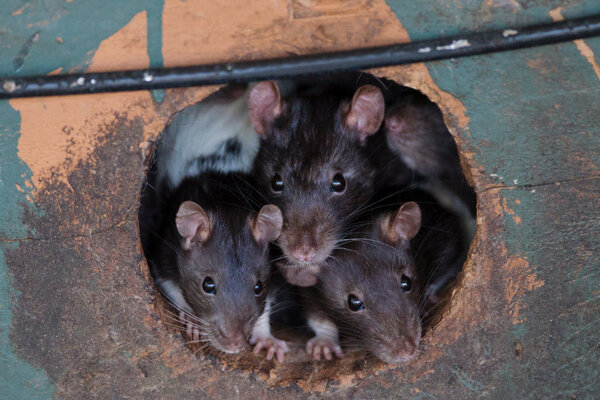


The researchers used electrodes to monitor the animals’ brain activity in three different situations: first, as the rats were shown food they couldn’t access, then as they rested in a separate area, and lastly, as they walked to the food. They found that brain cells involved in navigation showed similar activity when the rats were resting and when they were walking to and from the food, indicating that the brain was simulating or preparing future paths leading to a desired goal.

The process took up about 8 percent of the rats’ brain activity during sleep. While that may not sound like much, it’s still a lot of energy to give a single task during rest, Dr. Spiers told Discover magazine.

The results support the idea that sleeping improves performance on certain memory tasks, particularly those tied to a specific desire, the magazine reported.

“People are much better at doing the stuff that they’ll make more money on after they’ve slept,” Spiers said. “Something about sleep is using that desire information: that you do want to do better.”

Recommended: Name that animal!
The study stopped short of conclusively finding that rats dream these mental replays – “You can’t ask rats what they’re thinking or dreaming,” Spiers told Discover – but it does suggest that the ability to imagine future events is not unique to humans.

“What's really interesting is that the hippocampus is normally thought of as being important for memory, with place cells storing details about locations you’ve visited,” the study’s co-lead author, Dr. Freyja Ólafsdóttir, told Science Daily. “What’s surprising here is that we see the hippocampus planning for the future, actually rehearsing totally novel journeys that the animals need to take in order to reach the food.”

source: http://www.csmonitor.com/Science/2015/0629/Daydream-believer-Rats-dream-of-a-better-future


Recommended: Are you scientifically literate? Take our quiz -> http://www.csmonitor.com/Science/2011/1209/Are-you-scientifically-literate-Take-our-quiz

Stephen Covey - 4 Quadrantes - Modelo de gestão de tempo.

Stephen Covey tem um útil Modelo de 4 Quadrantes para gerir o tempo, é poderoso. Aqui está algumas ideias em como otimizar. Aonde está a gastar seu tempo?


Aonde estás no quadrante de Covey "Gestão de tempo."

Os 7 Hábitos de Pessoas Altamente Eficazes - de Stephen Covey (sumário e revisão)
Os 7 Hábitos de Pessoas Altamente eficazes é um dos mais influentes livros em Auto-Ajuda. Sempre foi um dos meus Favoritos e definitivamente recomendo a sua leitura.

Hábito 1 (0:00) : Ser pro-ativo.
Hábito 2 (1:30) : Começar com o final em mente.
Hábito 3 (2:19) : Pôr as primeiras coisas primeiro.
Hábito 4 (2:55) : Pense em Ganho-Ganho.
Hábito 5 (3:54) : Procure primeiro entender, do que ser entendido.
Hábito 6 (4:33) : Sinergia
Hábito 7 (5:10) : Afiar a lâmina.

https://www.facebook.com/FightMediocrity
https://twitter.com/fghtmediocrity


Todos nós encontramos dificuldade em pôr as nossas prioridades ordenadas e lidar com o gerenciamento de tempo. Quando se planeia os próximos passos para o dia ou onde queres ir estratégicamente durante o próximo ano e alguns anos, perceber as tuas prioridades é chave.

Tendo trabalhado com muitas empresas não lucrativas e micro empresas na criação de estratégias fortes eu descobri esta ferramenta útil.
Faça uma tentativa e diga-me o que pensa!

Desenha uma tabela com 4 quadrantes, e ordena cada tarefa em cada casa. Os quatro quadrantes são:

1.Necessidade (urgente e importante): emergências, prazos, reuniões bem preparadas. Isto precisa de ser feito primeiro.
2.Qualidade (importante): planejamento, implementação e seu próprio desenvolvimento. Maximize o tempo gasto nesta área, porque ele gera valor a longo prazo.
3.Decepção (urgente): e-mails, papelada, reuniões mal preparadas. Tente se livrar de tanto quanto possível.
4.Tóxico (não urgentes e não importantes): navegação. Leitura de vários posts no Facebook. Junk mails. Lixo é tóxico. Não toque nisso! Se precisares de uma pausa, encontra uma distração que não tem nada a ver com computadores.
Atribuir tarefas nos quatro quadrantes é uma boa maneira de fazer um rápido plano para o dia - especialmente no primeiro dia após as férias.


A questão e o sonho! por Paulo Azevedo

Sunday, June 28, 2015

Sabe qual é o maior empregador do Mundo?

Sabe qual é o maior empregador do mundo? Não é uma empresa.
23 Jun 2015 Carla Castro
Se pensa que está na China ou na Índia, engana-se. E os gigantes do retalho e da alimentação também só vêm na 3ª e 4ª posições.

Sabe qual é o maior empregador do mundo? Não é uma empresa.
Quando se fala no maior empregador do mundo, pensa-se que tem de estar na China ou na Índia, os países mais populosos do mundo. Mas não.

De acordo com um estudo do World Economic Forum, divulgado pela "Forbes", o maior número de empregados do mundo trabalha para Departamento de Defesa norte-americano: qualquer coisa como 3,2 milhões de pessoas.

Só em 2º lugar surge o Exército de Libertação do Povo, da China, que dá emprego a 2,3 milhões de pessoas.

A Walmart e a McDonald's (incluindo os franchises) vêm na 3ª e 4ª posições, com 2,1 e 1,9 milhões de empregados, respectivamente.

Surpreendentemente, o Serviço Nacional de Saúde (NHS) britânico surge no 5º lugar, com 1,7 milhões de empregados - mais do que os caminhos-de-ferro indianos e as forças armadas indianas.

Em 6º lugar aparece a China National Petroleum Corporation, com 1,5 milhões, em 7º a State Grid Corporation of China, também com 1,5 milhões, em 8º a Indian Railways, com 1,4 milhões, em 9º as Forças Armadas Indianas, com 1,3 milhões, e em 10º a Hon Hair Precision Factory (Foxconn), de Taiwan, com 1,2 milhões.

Thursday, April 16, 2015

How to play Chess ! Tips

Here is some compilation of tips to play chess!

#1 Protect your king
Get your king to the corner of the board where he is usually safer. Don’t put off castling. You should usually castle as quickly as possible. Remember, it doesn’t matter how close you are to checkmating your opponent if your own king is checkmated first!

#2 Don’t give pieces away
Don’t carelessly lose your pieces! Each piece is valuable and you can’t win a game without pieces to checkmate. There is an easy system that most players use to keep track of the relative value of each chess piece:
A pawn is worth 1
A knight is worth 3
A bishop is worth 3
A rook is worth 5
A queen is worth 9
The king is infinitely valuable

#3 Control the center
You should try and control the center of the board with your pieces and pawns. If you control the center, you will have more room to move your pieces and will make it harder for your opponent to find good squares for his pieces. In the example above white makes good moves to control the center while black plays bad moves.

#4 Use all of your pieces
In the example above white got all of his pieces in the game! Your pieces don’t do any good when they are sitting back on the first row. Try and develop all of your pieces so that you have more to use when you attack the king. Using one or two pieces to attack will not work against any decent opponent.

---
Mating Pre-requisites:
The main goal in chess is to mate the opponent. This can be done indirectly by creating a decisive material advantage, or via a straightforward mating attack. However, one shouldn’t aim for an assault in any position. If there are no prerequisites for it, you will probably run into trouble by forcing matters.

In most cases mating attacks occur in the middle game, but sometimes in the opening (due to careless play) or the endgame (even without queens on board). Let’s review the typical prerequisites of a mating attack:

1.Prerequisites based on the position!

1)Location of the king
If the king is in the centre, hasn’t castled or is exposed, it is worth considering attacking it. A king is a very slow piece. Should it get stuck in the centre while many pieces are in the game, it has great chances to be eliminated soon.

2)Lead in development
A player with a lead in development has more active pieces. This may become a good factor for starting an attack.

3)Pawn structure
When the king is safely hidden by a chain of pawns on their initial squares (e.g. f2-g2-h2), it is one thing. Typical pawn moves (g3, h3) create weak squares that can be exploited by the opponent.

4)Location of pieces
When most of your pieces are targeting the opponent’s king, it may serve as an indication of an upcoming attack. The rule of thumb is that it’s better to have more pieces in the attack than your opponent has in the defence. To simplify matters, some American authors assign $ value to pieces and calculate how large an “investment” each player has in the conflict.

5)Space advantage
Advantage in space allows one to maneuver and relocate the pieces quickly. In such situations the defender may not be able to regroup his forces as quickly as the attacker, and thus lose.

6)Command of the centre
This item is similar to the previous one. The player who has control of the centre has no difficulty transferring his pieces to attacking positions. When a piece is located in the center, it is usually more effective (especially knights).

7)Opposite-side castles
Opposite-side castles often lead to races on different sides of the board, when each player is trying to find the right balance between defending and attacking the opponent. Opposite-side castles allow the attacker to use pawns actively (e.g. sacrificing them to open up files) since his own king’s pawn shield won’t suffer (due to being placed on the other side of the board).

2.Prerequisites that are not based on positional factors!

1)Your opponent is afraid of attacks
By studying your opponent’s games, you may find out what types of positions he prefers and dislikes. If you see that he is a very poor defender, you may want to play actively.

2)Time trouble

It is very hard to defend well in time trouble, so the time factor can be used to one’s advantage too. However, one shouldn’t rely on reckless attacks and cheap tricks (hoping that the opponent will fall for them in time trouble) unless one is completely lost.
Sometimes a single prerequisite is enough for starting an attack, while in other cases a few are required. It is also important to keep an eye on your partner’s options. Quite often people are so excited about their attack that they go all-in, create structural weaknesses in their position and lose to counter-attacking players.

The following game was played in 2007. By reviewing it you will see a few methods of collaboration between pieces in an attack.
---
Some Opening Principles and Chess Strategies
Quick List of Chess Strategies:
* Avoid Moving a Chess Piece Twice During the Opening is a good chess strategy.
* It is Better Chess Strategy to Develop the Knights before Their Respective Bishops.
* A good chess strategy is to Develop Both Knights before the Queen’s Bishop.
* A good chess strategy is Do Not Develop your Chess Pieces Exclusively on One Side.
* A good chess strategy is as a Rule Do Not Play a Piece beyond Your Own Side of the Board in the Opening.
* A good chess strategy is if You Have Castled Do Not Permit the Opponent to Open a File on Your King.
* A good chess strategy is to Avoid Pinning the Opponent’s King’s Knight before He has Castled, Especially When You Have Yourself Castled on the King’s Side.
* A good chess strategy is to Avoid Making Exchanges which Develop Another Piece for the Opponent.
* A good chess strategy is to Avoid Exchanging Bishops for Knights Early in the Game.
* A good chess strategy is to Avoid Premature Attacks.

First read My System by Nimzovitch, next read something by Euwe, Fine, Kotov or Romanovsky - they all wrote excellent works on middle games and general strategic principles.

You should also work on endgame principles, try reading a general endgame book by Chernev, Euwe or Keres for starters. Fine Basic Chess Endings is indispensable as a general endgame reference book, but it's not meant to be read all the way through any more than a dictionary is.